
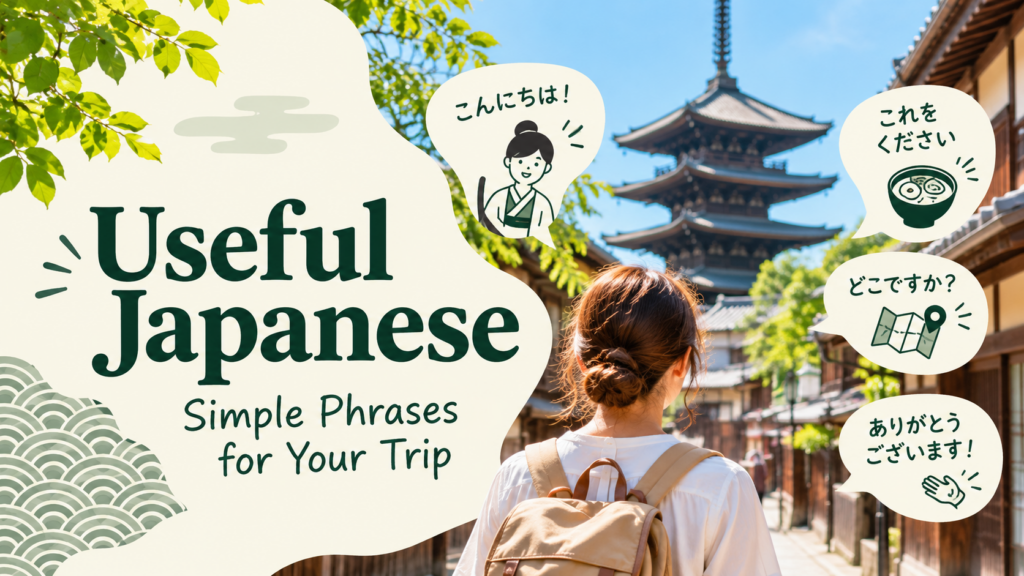
You don’t need to speak fluent Japanese to enjoy your trip to Japan. Learning a few simple phrases can make everyday situations easier, from ordering food and shopping to asking for directions and checking into your hotel.
This guide introduces useful Japanese expressions with English meanings and easy-to-read pronunciations. Save your favorite phrases before your trip, and use them whenever you need a little help communicating in Japan.
Quick Answer
Visiting Japan soon? Start with these 5 essential Japanese phrases. They are simple to remember and useful in many everyday situations.
- こんにちは (Konnichiwa) Hello.
- ありがとうございます (Arigato gozaimasu) Thank you very much.
- すみません (Sumimasen) Excuse me / I’m sorry.
- これをください (Kore wo kudadsai) This one, please.
- 英語を話せますか? (Eigo wo hanasemasu ka?) Do you speak English?
What you need to know
Greetings and Polite Expressions
Simple greetings and polite expressions can make everyday interactions in Japan more comfortable. Even if you speak only a little Japanese, a friendly greeting and a sincere thank-you are a great way to connect with people during your trip.
| Japanese | Pronunciation | Meaning |
| こんにちは | Konnichiwa | Hello |
| おはようございます | Ohayou gozaimasu | Good morning |
| ありがとうございます | Arigatou gozaimasu | Thank you very much |
| すみません | Sumimasen | Excuse me / I’m sorry |
| お願いします | Onegaishimasu | Please |
When in doubt, use polite expressions such as “Arigatou gozaimasu” (Thank you very much) and “Sumimasen” (Excuse me). A friendly attitude and a little effort to speak Japanese can go a long way!
Asking for Help
Knowing how to ask for help in Japanese can make your trip much easier. Whether you need someone to speak slowly, repeat something, or help you find your way, these simple phrases can help you communicate even if you don’t speak Japanese fluently.
| Japanese | Pronunciation | Meaning |
| 英語を話せますか? | Eigo wo hanasemasu ka? | Do you speak English? |
| 助けてください | Tasukete kudasai | Please help me. |
| わかりません | Wakarimasen | I don’t understand. |
| もう一度お願いします | Mou ichido onegaishimasu | One more time, please. |
| ゆっくり話してください | Yukkuri hanashite kudasai | Please speak slowly. |
If you don’t understand something, say “Sumimasen” to get someone’s attention, then use a translation app to help explain what you need.
At a Restaurant
Knowing a few useful Japanese phrases can make ordering food much easier. Whether you’re asking for a menu, choosing a dish, or requesting the bill, these expressions will help you feel more confident when dining out in Japan.
| Japanese | Pronunciation | Meaning |
| メニューをください | Menyu wo kudasai | The menu, please. |
| これをください | Kore wo kudasai | This one, please. |
| おすすめは何ですか? | Osusume wa nandesuka? | What do you recommend? |
| お水をください | Omizu wo kudasai | Water, please. |
| お会計お願いします | Okaikei onegaishimasu | The bill, please. |
| 持ち帰りできますか? | Mochikaeri dekimasuka? | Can I get this to go? |
When ordering, you can point to an item on the menu and say “Kore wo kudasai.” This simple phrase is useful even if you don’t speak much Japanese.
Asking for Directions
Getting around Japan is easier when you know a few simple phrases for asking directions. Use the expressions when looking for a train station, a tourist attention, or a nearby facility.
| Japanese | Pronunciation | Meaning |
| 駅はどこですか? | Eki wa doko desuka? | Where is the station? |
| ここへはどう行きますか? | Koko e wa dou ikimasuka? | How do I get here? |
| これはどこですか? | Kore wa doko desuka? | Where is this place? |
| 近くにコンビニはありますか? | Chikakuni konbini wa arimasuka? | Is there a convenience store nearby? |
| どのくらいかかりますか? | Dono Kurai kakarimasuka? | How long does it take? |
| 地図を見せてください | Chizu wo misete kudasai | Please show me the map. |
Showing a map on your phone while asking “Eki wa doko desuka?” Can make it easier for someone to understand where you want to go.
At a Hotel
A few simple Japanese phrases can help you communicate with hotel staff during check-in, when asking about facilities, or when requesting assistance with your room.
| Japanese | Pronunciation | Meaning |
| チェックインお願いします | Chekkuin onegaishimasu | I’d like to check in. |
| 予約しています | Yoyaku shiteimasu | I have a reservation. |
| Wi-Fiはありますか? | Wi-Fi wa arimasuka? | Is Wi-Fi available? |
| 朝食は何時ですか? | Choushoku wa nanji desuka? | What time is breakfast? |
| タオルをいただけますか? | Taoru wo itadakemasuka? | Could I have a towel? |
| チェックアウトは何時ですか? | Chekkuauto wa nanji desuka? | What time is check-out? |
When checking in, prepare your reservation details and passport. Saying “Yoyaku shiteimasu” before showing your booking confirmation is a helpful way to start.
When Something Goes Wrong
Unexpected situations can happen while traveling. These phrases can help you explain a problem, ask someone to repeat information, or request assistance.
| Japanese | Pronunciation | Meaning |
| わかりません | Wakarimasen | I don’t understand. |
| もう一度お願いします | Mou ichido onegaishimasu | One more time, please. |
| ゆっくり話してください | Yukkuri hanashite kudasai | Please speak slowly. |
| 財布を失くしました | Saifu wo nakushimashita | I’ve lost my wallet. |
| 携帯電話を失くしました | Keitaidenwa wo nakushimashita | I’ve lost my phone. |
| 手伝っていただけますか? | Tetsudatte itadakemasuka? | Could you help me? |
If you have trouble explaining a problem, try showing a translation app or writing down what you need to say. You can also use “Sumimasen” to politely get someone’s attention.
Emergency
Knowing a few emergency phrases before you trip can help you communicate when you need urgent assistance. Save these expressions on your phone so you can find them quickly.
| Japanese | Pronunciation | Meaning |
| 助けてください | Tasukete kudasai | Please help me. |
| 救急車を呼んでください | Kyuukyuusha wo yonde kudasai | Please call an ambulance. |
| 警察を呼んでください | Keisatsu wo yonde kudasai | Please call the police. |
| 病院はどこですか? | Byouin wa doko desuka? | Where is the hospital? |
| 気分が悪いです | Kibun ga warui desu | I feel sick. |
| 英語を話せる人はいますか? | Eigo wo hanaseru hito wa imasuka? | Is there anyone who speak English? |
In Japan, call 119 for an ambulance or fire emergency, and 110 for the police. If you need urgent help, state your location clearly and use short, simple phrases.
Emergency numbers: 119 is for the fire and ambulance services; 110 is for police emergencies.
Final Tips for using Japanese in Japan
You don’t need to speak perfect Japanese to enjoy your trip to Japan. Learning a few simple phrases can help you communicate with locals, order food, find your way, and handle unexpected situations.
Start with greetings like “Konnichiwa” and polite expressions like “Sumimasen” and “Arigatou gozaimasu.” Even a little Japanese can make everyday interactions easier and more enjoyable.
If you’re unsure what to say, don’t worry! You can use a translation app, show someone your phone, or simply ask for help politely.
Enjoy your trip to Japan, and have fun learning a little Japanese along the way!
Keep Exploring Japan
Continue planning your trip with these practical guides to Japan.